Korean Embassy Cancels 2025 K-Pop World Festival in Israel#
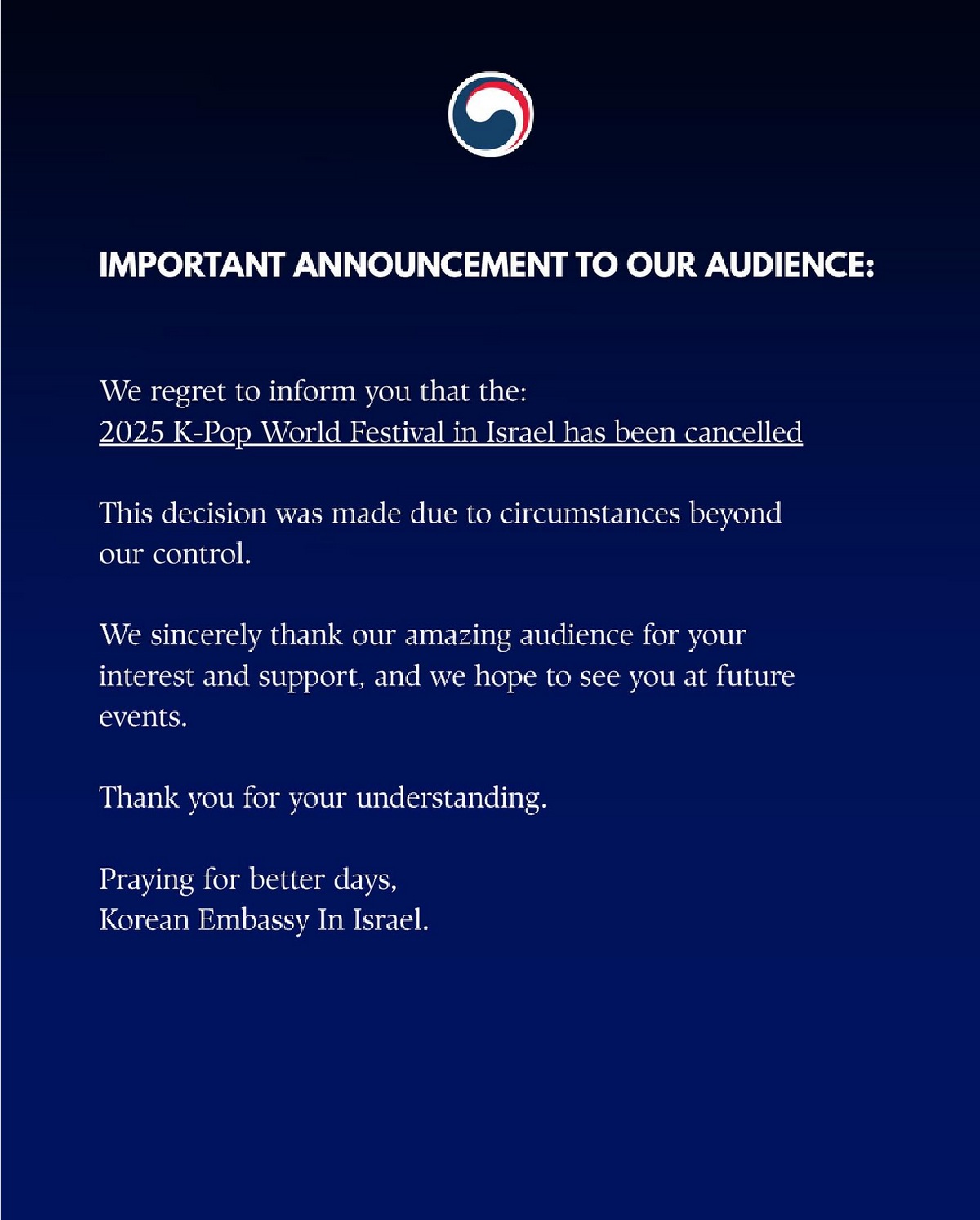
The Korean Embassy in Israel has officially announced the cancellation of the 2025 K-Pop World Festival in Israel, citing “circumstances beyond our control” in a formal statement posted on their Instagram account.
The announcement, which features the official Korean government seal, expresses regret over the decision and thanks supporters for their “interest and support,” while hoping to “see you at future events.”
View the original announcement: Korean Embassy in Israel Instagram Post
Background and Context#
The festival was originally scheduled as part of the global K-Pop World Festival series, with Israel set to host a preliminary competition at Tel Aviv University on July 10, 2025. Applications were open until March 31, 2025, making this a last-minute cancellation.
International Pressure and Fan Activism#
The cancellation comes amid sustained international pressure from K-pop fan communities worldwide, who launched boycott campaigns against Israel’s participation in the festival. Fans organized under hashtags like #KpopFestivalOutWithZionism, accusing organizers of “artwashing genocide” in relation to the ongoing conflict in Gaza.
The campaign gained momentum following the death of Palestinian K-pop fan Tia, whose family was killed in an Israeli airstrike, highlighting the human cost of the conflict for the global K-pop community.
Security and Diplomatic Considerations#
While the embassy’s statement cites vague “circumstances beyond our control,” several factors likely influenced the decision:
- Regional Security Concerns: The ongoing conflict in Gaza and regional instability posed potential safety risks for participants and organizers
- Diplomatic Balancing: South Korea faced pressure to balance its traditional alliance with Israel against growing international criticism
- Cultural Soft Power Protection: The controversy threatened to damage K-pop’s global appeal and South Korea’s cultural diplomacy efforts
Implications for Korea-Israel Relations#
This marks a rare instance where South Korea has prioritized international public sentiment over established diplomatic partnerships. The decision reflects the growing influence of transnational fan communities in shaping cultural diplomacy outcomes.
While economic and military cooperation between South Korea and Israel continues, the cancellation signals Seoul’s awareness of shifting global attitudes toward the Israeli-Palestinian conflict, particularly among younger demographics who form K-pop’s core audience.
What It Means for the K-Culture Community in Israel#
For the Korean-culture community in Israel — both the small resident Korean population and the much larger circle of Israeli K-pop and K-drama fans — the cancellation was felt as more than a logistical disappointment. The Israel preliminary of the K-Pop World Festival, run for several years at Tel Aviv University’s Smolarz Auditorium, had become one of the few fixed points on the calendar where that community gathered in person: a place for cover-dance crews, vocalists and fans to meet offline rather than through screens.
Losing it removed a rare public-facing venue for a community that, like other Asian-interest scenes in Israel, is otherwise dispersed and largely organised online. It also placed Israeli fans in an uncomfortable position — caught between a global fandom that increasingly frames participation as a political act, and a local scene that experiences K-pop simply as culture they love. The festival’s absence has not, in practice, diminished day-to-day engagement: Korean restaurants, groceries and study groups around the country continue to draw steady interest, and for readers looking to connect with that scene our guide to the https://asiansinisrael.com/2026/05/best-korean-restaurants-israel/ is a practical starting point. But the cancellation underlined how exposed cultural-exchange events are when diplomacy and grassroots activism collide.
Current Status#
As of mid-2026, the K-Pop World Festival has not returned to Israel. No Israel preliminary was announced for 2026, and the Korean Embassy has not published a revised date or a replacement event. The festival’s global series has continued elsewhere, but Israel’s slot remains effectively suspended rather than formally restored — a quiet continuation of the 2025 cancellation rather than a resolution of it. Readers should treat the festival as on indefinite hold until the embassy says otherwise.
Embassy Statement#
The Korean Embassy concluded its announcement by stating: “We sincerely thank our amazing audience for your interest and support, and we hope to see you at future events. Thank you for your understanding. Praying for better days, Korean Embassy In Israel.”
The full announcement can be viewed on the Korean Embassy in Israel’s Instagram page, where it was originally posted.
This cancellation sets a precedent for how cultural exchanges may be affected by geopolitical conflicts and grassroots activism in the digital age, demonstrating the complex intersection of entertainment, diplomacy, and human rights advocacy.
View this post on Instagram