Israel Population and Immigration Authority Expands Emergency Preparedness Outreach with Multilingual Videos
The Israel Population and Immigration Authority (רשות האוכלוסין וההגירה) has launched a series of emergency preparedness videos specifically designed for foreign workers, available in Chinese, Hindi, and Thai languages. This initiative represents a significant step in ensuring that Israel’s diverse foreign worker population has access to critical safety information during emergencies.
Multilingual Video Series#
The authority has released three dedicated videos on YouTube, each tailored to specific language communities:
- Chinese Version: Emergency Preparedness Guide
- Thai Version: Emergency Preparedness Guide
- Hindi Version: Emergency Preparedness Guide
These videos provide essential information about emergency protocols, shelter procedures, and safety measures that foreign workers need to know while living and working in Israel.
Context and Importance#
Israel currently hosts over 42,000 foreign workers in the agricultural sector alone, with additional thousands working in construction, healthcare, and other industries. The majority of these workers come from Thailand, India, and other Asian countries, making multilingual emergency preparedness materials essential for public safety.
The timing of this initiative is particularly significant given Israel’s current security situation and the need for comprehensive emergency preparedness across all population segments. Foreign workers, who may not be fluent in Hebrew or Arabic, require accessible information to ensure their safety during various emergency scenarios.
Foreign Worker Demographics#
According to recent data, Israel’s foreign worker population includes:
- Thai workers: Primarily employed in agriculture, with 13,000 new permits issued in 2025
- Indian workers: Mainly in construction and specialized sectors, with 16,000 workers arriving since October 2023
- Chinese workers: Across various industries including technology and manufacturing
These communities represent a significant portion of Israel’s workforce, particularly in essential sectors like agriculture and construction that are vital to the country’s economy and food security.
Emergency Preparedness Focus#
The videos likely cover key emergency preparedness topics relevant to foreign workers, including:
- Understanding Israel’s alert system and siren warnings
- Locating and accessing protected spaces and bomb shelters
- Emergency contact information and procedures
- Workplace safety protocols during security incidents
- Communication channels for emergency updates
Government Initiative#
This multilingual outreach effort demonstrates the Population and Immigration Authority’s commitment to ensuring that all residents of Israel, regardless of their native language, have access to life-saving emergency information. The initiative aligns with Israel’s broader emergency preparedness strategies that have been enhanced following recent security challenges.
The creation of these videos reflects recognition that effective emergency preparedness requires inclusive communication that reaches all segments of the population. By providing information in Chinese, Hindi, and Thai, the authority addresses the linguistic needs of some of Israel’s largest foreign worker communities.
Broader Implications#
This initiative represents part of Israel’s evolving approach to integrating foreign workers into the country’s emergency preparedness framework. As Israel continues to rely on foreign workers in critical sectors, ensuring their safety and preparedness becomes increasingly important for overall national resilience.
The multilingual video series also demonstrates how government agencies are adapting their communication strategies to serve Israel’s increasingly diverse population, recognizing that effective emergency preparedness requires reaching every community in their preferred language.
Foreign workers and their employers are encouraged to view these videos and incorporate the information into their workplace safety protocols and personal emergency preparedness plans.
How to Use These Resources — Practical Guide#
If you are a foreign worker, student or family member who does not speak Hebrew fluently, here is how to make these resources actually work for you.
The three videos, by language:
- Chinese — youtube.com/watch?v=DDGd5-Ywx7w
- Thai — youtube.com/watch?v=IBl_OyGL9EI
- Hindi — youtube.com/watch?v=3I58sq4eQMs
Note that the Population and Immigration Authority’s videos cover Chinese, Hindi and Thai — they do not (as of this review) include Korean, Japanese, Vietnamese or Tagalog. Korean and Japanese speakers, and Filipino workers, should rely on the multilingual Home Front Command app and the assistance line below.
Watch the video once now, not during an emergency. Save the link for your language, watch it before you ever hear a siren, and share it with housemates and co-workers who speak the same language. During an actual alert there is no time to look anything up.
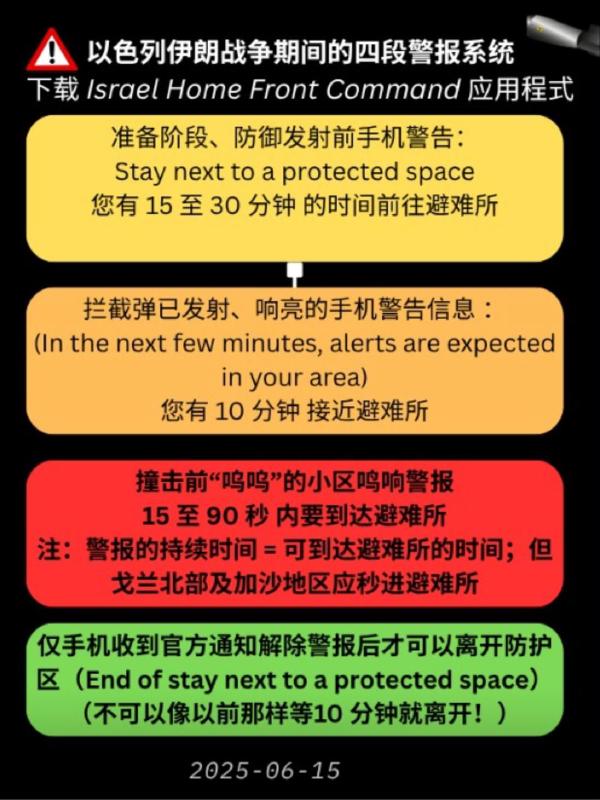
Pair the video with the Home Front Command app. The official Israel Home Front Command app is available in Hebrew, Arabic, Russian and English, and it delivers the real-time staged alerts. The PIBA videos explain what to do; the app tells you when. Install the app, set it to a language you understand, and keep notifications on.
Know who to call. During the security situation, PIBA operates a multilingual inquiry and assistance line for foreign workers: 1-700-707-889. Use it for questions about your status, your safety, or your rights as a worker during the emergency. Save the number in your phone now.
For employers and recruitment agencies. If you employ foreign workers, do not assume watching a video is enough. Walk each worker physically to the protected space, confirm they understand the siren and the all-clear, and check that they have the app installed in their language.
Related Practical Guides#
- Israel’s Four-Stage Alert System: A Guide to Home Front Command Warnings — what each alert colour means and how much time you have, explained for non-Hebrew speakers
- PIBA guidance webinars for foreign worker employers — sector-specific emergency guidance for employers, including a recorded Thai workers session
- Israel automatically extends visas expiring through May 2026 — keeping your legal status valid while PIBA offices run on emergency hours